Employee productivity / Practical guide
Employee Productivity Monitoring Tools That Work
Use activity data to find slow handoffs, repeated work, and software delays, then measure improvements against completed work.

Employee productivity monitoring tools are most useful when a team is busy but work still queues up. Application time and idle periods can point to slow approvals, duplicate entry, or unreliable software. Compare those signals with completed tasks and quality measures to identify the bottleneck before judging individual effort.
For small and midsize businesses, the goal is not to watch every employee for its own sake. The goal is to protect paid work time, company data, customer information, and the systems required to keep operations moving. The right platform shows where work is happening, where it is stopping, and where management needs to intervene.
01Measure workflow bottlenecks with productivity monitoring tools
A basic time tracker can show that someone signed in at 8:00 a.m. It cannot show whether they worked in the approved applications, repeatedly visited distracting sites, transferred sensitive files, or left an important workstation idle. Monitoring software should provide a fuller operational record.
At a minimum, administrators need visibility into application use, website activity, active and idle time, processes running on company computers, and employee screen activity. Reports should be filterable by user, department, date, application, website, or activity type. Without useful filters, monitoring data becomes a large archive that managers do not have time to review.
Screen viewing and recording add necessary context. A report may show that an employee spent three hours in a browser, but a screen record can distinguish legitimate customer research from streaming video, personal shopping, or an unapproved web application. Live screen monitoring is equally useful when a manager needs to confirm that a new process is being followed or determine why a task is delayed.
The most practical systems also move beyond observation. If an employee is using a prohibited website or unapproved application, administrators should be able to block it. If a remote computer has a problem, IT should be able to connect, transfer a required file, restart the machine, run a command, or restrict a device without waiting for the employee to bring the endpoint into the office.
02Monitoring Is Most Valuable When It Leads to Action
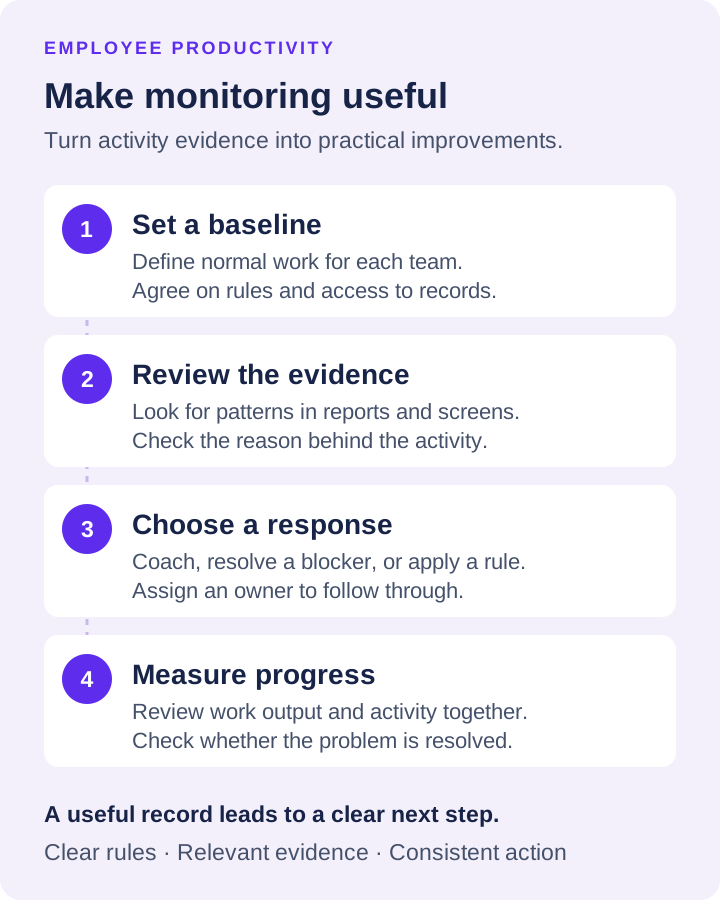
Collecting activity data without a response plan wastes administrative time. Before deploying software, decide which events require a manager conversation, an IT response, or an immediate restriction. This keeps monitoring focused on business outcomes rather than minor variations in individual work habits.
For example, frequent idle time may point to time theft, but it can also reveal a broken workflow. A customer service representative may be waiting for access to a system, an approval, or a response from another department. Repeated use of a personal file-sharing site may signal misconduct, or it may show that employees lack an approved way to exchange large files. The record matters, but the reason behind the record matters too.
Managers should use monitoring results to identify patterns. One isolated visit to a non-work website is rarely a priority. A recurring pattern of extended personal browsing during paid hours is different. Likewise, one unauthorized application may be a training issue. The same unapproved software installed across several devices may indicate a policy gap or a serious security exposure.
This approach protects productive employees as well. Clear evidence prevents managers from making decisions based on rumors, visible office presence, or the person who speaks most often in meetings. Work output and documented activity provide a more defensible basis for coaching, recognition, and corrective action.
03Key Capabilities to Evaluate Before You Buy
Employee monitoring requirements vary by team size, work location, and risk level, but a few capabilities make the difference between a reporting tool and an operational control system.
Live Screens, Recording, and Playback
Live thumbnails and full-screen viewing let supervisors verify activity when an issue needs immediate attention. Recording creates an auditable record for investigations, training reviews, policy enforcement, and disputes over how work was performed. Look for configurable recording schedules and storage settings so you can capture the evidence you need without creating unnecessary files.
Recording storage deserves close attention for distributed teams. Businesses may need to retain data on a local server or send it to SMB shares, FTP, SFTP, WebDAV, Amazon S3-compatible storage, Google Cloud Storage, or Azure Blob Storage. The best choice depends on existing infrastructure, retention requirements, available bandwidth, and who needs access to recordings.
Website, Application, and Process Tracking
Website logs reveal where browser time goes. Application tracking shows whether employees use the tools required for their roles. Process monitoring helps IT identify unauthorized software, suspicious executables, and applications consuming system resources.
These controls are especially useful for remote and hybrid staff. A manager cannot rely on seeing who is sitting at a desk, and an employee working off-network may still access company files and services. Monitoring installed on company-owned endpoints maintains visibility wherever the device is used.
Compare activity with output and quality
Compare equivalent work before and after a change. For example, review invoice-processing time alongside completed invoices, correction rates, and the time spent waiting for approval. Application reports help locate the interval; the finance system supplies the output measure. A reduction in keyboard activity can be a success if an improved process removes duplicate entry.
Change one bottleneck at a time, such as an approval handoff or a slow application. Review the next comparable period with the team and check whether turnaround improved without more errors. Do not use keystroke volume or audio capture as default productivity measures. For detailed program-level evidence, use the application usage guide.
Remote Administration and Restrictions
Monitoring is more effective when administrators can correct problems immediately. Website and application blocking reduce repeat distractions and prevent use of risky services. Device restrictions can limit removable media or other pathways for unauthorized data movement. Remote file management, power controls, desktop sharing, and command execution help IT support endpoints without costly desk-side visits.
For a growing business, combining these functions in one console reduces the burden of switching between separate monitoring, remote support, and endpoint-control products. It also means the person reviewing a suspicious event can take action while the evidence is current.
04Set Rules Before You Turn Monitoring On
A monitoring deployment should begin with a written policy, not a surprise. Employees should understand that company-owned devices and accounts are used for business purposes, what activity may be monitored, who can access the records, and how long records are retained. Requirements differ by location and circumstance, so consult qualified legal counsel on notice, consent, recording, and privacy obligations that apply to your workforce.
Operationally, define roles inside the platform. Department managers may need productivity reports and live-screen access for their teams. IT administrators may need process data, endpoint controls, and remote management authority. Security personnel may need access to investigation records. Not every supervisor needs access to keystrokes, recordings, or every employee's screen.
Start with a baseline period. Review normal use of approved applications, common websites, idle patterns, and typical work hours before setting alerts or restrictions. A design team, a sales team, and an accounting team will not have the same activity profile. Baselines prevent the system from flagging legitimate work simply because it looks different from another department's work.
05A Practical Rollout for Small and Midsize Businesses
Begin with a limited group of company computers, preferably a department with a defined workflow and a manager prepared to review the results. Test reports, recording settings, storage destinations, and remote-control permissions. Confirm that data is accessible when needed and that the system does not create an unmanageable volume of alerts or recordings.
Then establish a review cadence. Managers may review productivity reports weekly, while IT reviews unauthorized applications and security-related events daily or as alerts occur. Critical policy violations should have an assigned owner and a documented response process. If nobody owns the response, the monitoring system will become another dashboard that employees learn to ignore.
Net Monitor for Employees Pro is designed for this hands-on model, combining screen visibility, recording, detailed activity logs, content restrictions, and remote administration in one administrator-focused system. A fully functional no-registration trial gives IT teams a direct way to test whether its controls and reporting fit their environment before licensing.
The useful question is not whether a business should collect more employee data. It is whether management can turn verified activity into faster decisions, safer endpoints, and better use of paid time. Set clear rules, monitor the systems you own, and act consistently when the evidence shows a problem.