
Employee Screen Recording with Computer Screen Recorder
Desktop Recorder can be used to record employee screen activity on remote computers for later investigation.
This feature allows managers to keep clear proof of what happened, even when they were not watching live.
Typical use cases include:
- Checking what happened before a support issue or security incident.
- Keeping recordings of employee activity as proof for later use.
- Reviewing employee work flow and discussing improvements during follow-up meetings.
- Coaching new employees using real examples from past recordings.
- Confirming repeated policy violations with visual evidence.
Desktop Recorder
Desktop Recorder captures remote screens as JPEG snapshots or MKV/MPEG4 video files. You can run it manually, by schedule, or tied to console connection status.
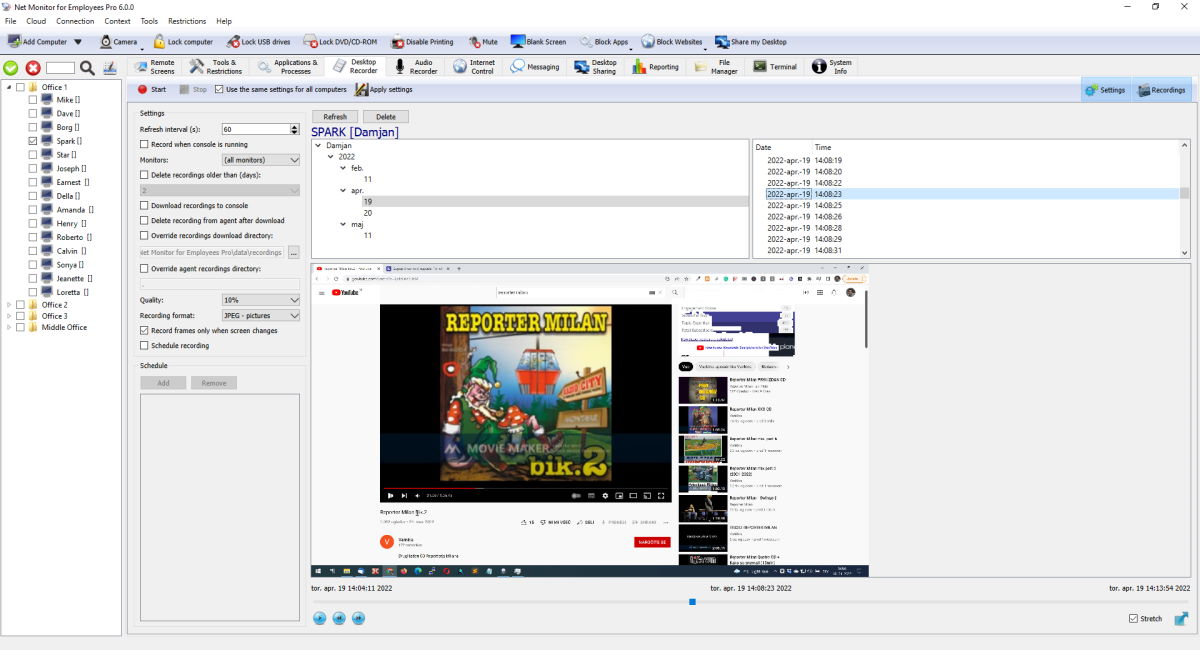
Top Toolbar
- Start applies current settings first, then starts recording on selected computers (after confirmation).
- Stop stops recording on selected computers (after confirmation).
- Use the same settings for all computers controls scope: enabled = one profile for all computers, disabled = selected computers only.
- Apply settings sends configuration changes without forcing Start/Stop.
- If settings were changed and not applied yet, Apply settings blinks red.
- Settings and Recordings buttons show/hide left configuration panel and right recordings panel.
Left Settings Panel
- Refresh interval (s): capture period. Lower values increase detail and storage usage. Recorder captures at about one frame per second minimum.
- Record when console is running: starts when console connects and stops when console disconnects (unless schedule is currently active).
- Monitors: select primary monitor, all monitors, or a specific monitor index.
- Delete recordings older than (days): automatic retention cleanup.
- Recording storage: select local agent storage or a named external storage profile.
- Download recordings to console: enables automatic background download from agents.
- Delete recording from agent after download: removes remote file after successful transfer.
- Override recordings download directory: custom local archive path. If disabled, default console recordings folder is used.
- Override agent recordings directory: custom recording path on monitored computer.
- Quality: 0% to 100% compression quality.
- Recording format: JPEG sequence, MKV video, or MPEG4 video.
- Max file size (Mb): available for video formats only. When limit is reached, recorder starts a new file. (don't limit) means unlimited.
- Record frames only when screen changes: skips duplicate frames and reduces storage/network usage.
- Schedule recording: enables schedule rules below. Use Add/Remove to create entries by weekday and all-day or time interval.
Right and Bottom Panels (Recordings Browser + Player)
- Refresh reloads filters and recording list.
- The first, unlabeled column shows whether a recording is downloaded to this console, encrypted, and stored on external storage. The icons are shown in that order.
- Save as video... combines the selected recordings in time order into one Matroska (MKV, default) or MPEG-4 video. The progress dialog can be moved to the background, where progress and the Stop button remain available in the status bar. Encrypted recordings are decrypted temporarily when the matching key is available; agent-only recordings must first be downloaded.
- Delete removes selected recordings from agent and local downloaded archive.
- Filter tree groups recordings by User → Year → Month → Day.
- Recording list shows Date/Time; selecting an item positions playback to that recording.
- Player timeline spans all recordings in selected filter, not just one file.
- Player controls: Play/Pause, Previous, Next, Stretch, and Full Screen.
- Downloaded local files are merged with remote files in one list so playback works online and offline.
Local Storage and Download
When download is enabled, the console periodically checks connected agents, queues missing files per host, downloads through a temporary local folder, and then moves completed files into the final archive path. Optional delete-after-download is applied after successful transfer.
External and Cloud Storage
See External Storage Configuration for provider-specific fields, credential sources, required permissions, and setup steps.
Desktop recordings can be uploaded directly by each agent to SMB 2/3, SMB 1.0, FTP, WebDAV, SFTP, Amazon S3 or compatible S3 storage, Google Cloud Storage, and Azure Blob Storage.
- Create named profiles under File / Configuration / External Storage, then use Test connection.
- Select the profile under Recording storage and apply settings to the required agents.
- Files are organized as folder / agent host name / desktop-recordings.
- Existing local recordings are queued for upload when an agent is switched to external storage.
- Failed uploads remain pending on the agent and are retried; cached recordings remain available while the agent is offline.
- Optional quotas can delete the oldest recordings or stop recording with an error. The recorder shows occupied recording space.
Security warning: SMB 1.0 and FTP are unsafe legacy protocols. Prefer SMB 2/3, SFTP, WebDAV over HTTPS, or an HTTPS object-storage endpoint.
End-to-End Encryption
Encrypt recordings protects local and external-storage files. See End-to-End Recording Encryption for key backup, selected recordings, remote conversion, rotation, and recovery.
Use Decrypt all recordings... to stop encrypting new recordings and convert existing console and selected external-storage files in the background. Encrypted originals are removed only after verification; agent-only recordings must first be downloaded. To create unencrypted copies without changing stored originals, select recordings and click Save unencrypted....
Recommended Setup
For long-term low-storage recording, use JPEG + screen-change detection + longer interval.
Ready to start monitoring your employees?
Buy this application now. You will never regret your decision.
Buy Now