Multi-screen monitoring / Practical guide
How to Monitor Multiple Computer Screens at Work
Set up one console for many computers, organize readable screen groups, and tune refresh settings for your network.
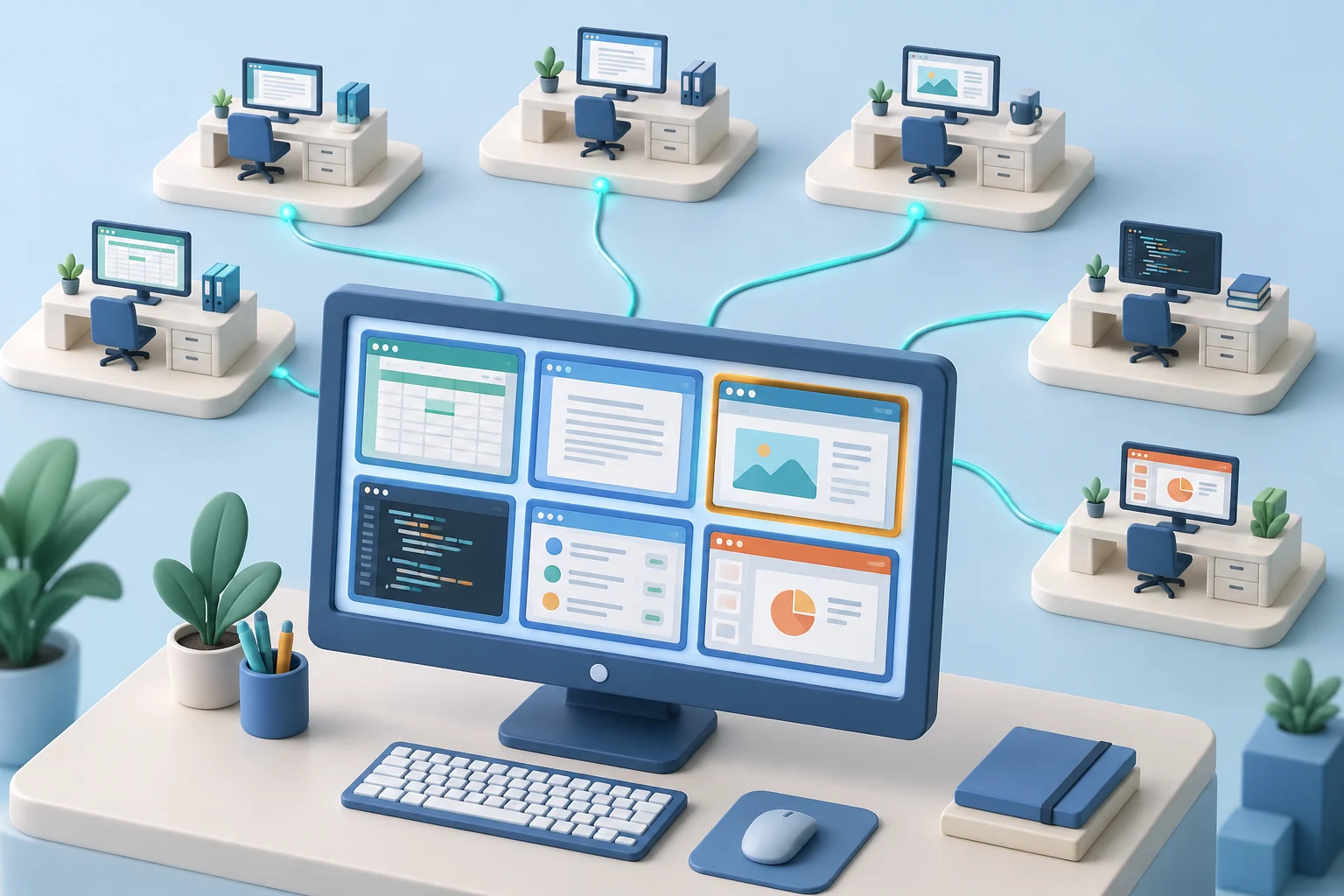
To monitor multiple computer screens, you need a central console displaying desktops from separate managed computers. This differs from connecting several physical monitors to your own PC. The practical challenge is keeping a growing screen grid readable, current, and organized so a supervisor can spot a problem and open the right device.
This is not about watching every employee for its own sake. It is about managing company-owned systems, protecting business data, enforcing acceptable-use rules, and resolving problems before they become expensive. The right setup lets authorized managers see what matters, investigate exceptions, and act without disrupting the entire workforce.
01Monitor multiple computers from one screen grid
A single computer can be managed informally. A team of 10, 25, or 100 endpoints cannot. Once employees work across offices, homes, customer locations, and travel schedules, fragmented oversight creates blind spots. A supervisor may see completed work but miss the hours of blocked progress, personal browsing, unauthorized software, or data handling that occurred beforehand.
Central screen monitoring replaces assumptions with evidence. A live thumbnail view can show whether a team is working in the required business application, stuck in an error loop, or using a system outside its assigned purpose. When a user reports that a program is slow or a file is missing, IT can inspect the desktop remotely instead of relying on incomplete descriptions.
The security value is just as direct. Unapproved remote-access tools, suspicious downloads, personal cloud storage, and attempts to bypass policy often appear first as visible desktop activity. Screen monitoring does not replace endpoint protection, access controls, or audit logs. It adds operational context that automated alerts alone may not provide.
02Start with a defined monitoring purpose
Before installing any monitoring agent, decide what your organization needs to see and who has authority to see it. A sales manager may need visibility into CRM usage and follow-up workflows. IT may need access to all company endpoints for troubleshooting, application control, and incident response. Security personnel may need reports and recordings when investigating a specific policy violation.
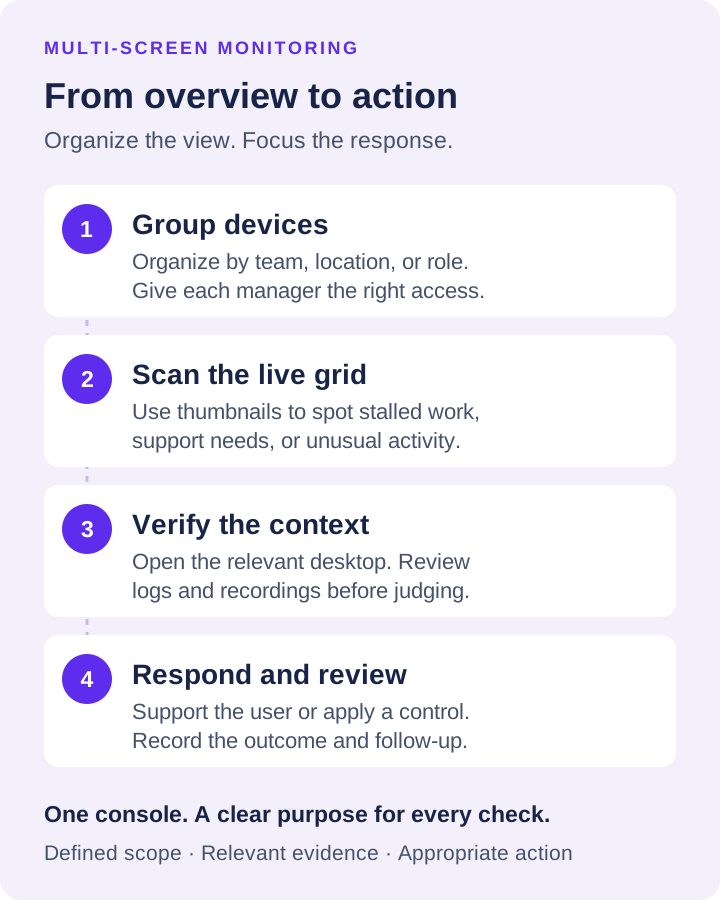
Avoid treating every screen equally. Create logical groups based on department, location, role, or risk level. For example, finance devices may need tighter controls around file transfers and cloud services, while a support team may need closer attention to response tools and approved knowledge bases. Grouping systems makes a large screen grid manageable and reduces unnecessary access to information outside a manager's responsibility.
A written acceptable-use and monitoring policy matters here. Inform employees that company devices and accounts may be monitored, explain the business reasons, identify the types of activity collected, and apply the policy consistently. Requirements differ by state, industry, employment agreement, and whether a device is company-owned or personally owned. Use legal and HR guidance to set the policy before expanding surveillance.
03Build a screen view that supports fast decisions
In the screen-view settings, use Filter to select a group and Thumbnail size to balance the number of visible computers against readable detail. Keep original aspect ratio avoids stretched previews. For a computer with several displays, Extend multiple monitor screen shows its desktop as an extended area.
Do not confuse frequent viewing with effective oversight. Constantly staring at a wall of desktops wastes management time and can create noise. The better approach is to use live views for active supervision, support, and exception handling, then rely on recorded activity and reports for investigation.
Test the grid with the number of computers you expect to supervise. Increase Refresh interval if frequent updates strain the connection, and open an individual desktop when a thumbnail is too small. Show connected only reduces clutter, but review disconnected devices separately so a hidden computer is not mistaken for a healthy one.
Screen recording extends that visibility beyond the moment. Live viewing tells you what is happening now. Recording shows what happened before a complaint, error, security alert, or productivity issue was reported. For organizations that need an auditable record, recordings can be retained according to policy and stored on local infrastructure or approved cloud-compatible storage.
04Combine screen monitoring with activity evidence
A screen image alone rarely answers the full question. It shows what was visible at a moment in time, but it may not show duration, application history, websites visited, running processes, keystroke events, or attempted file activity. That is why effective employee oversight combines several types of evidence.
Application and website reports reveal usage patterns over days or weeks. Filtering lets managers focus on a department, user, date range, application, or domain rather than sorting through irrelevant data. Process monitoring can expose prohibited utilities or software that consumes system resources. Keystroke logging and desktop recording may be appropriate for a defined investigation where the company needs a detailed record of actions taken on a managed device.
Use the least intrusive level of review that solves the business problem. A monthly application report may be enough to identify recurring distractions. A live screen view may be enough to help an employee who is blocked. Detailed recordings should be reserved for security reviews, compliance needs, performance investigations, or other documented business reasons. This approach keeps oversight purposeful and easier to defend.
05Take action instead of only collecting evidence
Monitoring that produces no operational response becomes an archive of missed opportunities. When you identify a recurring issue, use the available controls to correct it.
If employees repeatedly access distracting or risky websites, block those domains or categories through a clear policy. If unauthorized applications appear, restrict them and investigate how they were installed. If an endpoint is unresponsive, IT may need to send a command, restart the computer, manage files remotely, or connect for desktop assistance. When a device presents a security concern, access can be restricted while the incident is reviewed.
This is where an all-in-one administration platform has an advantage over a collection of disconnected tools. Net Monitor for Employees Pro can provide live screen viewing, desktop recording, activity logging, reporting, website and application restrictions, and remote administration from one administrative environment. That reduces the delay between identifying a problem and taking a controlled response.
Authority should be assigned carefully. Department managers may need reports and limited live viewing, while IT administrators need broader endpoint controls. Security leaders may need access to recordings and investigation exports. Role-based practices reduce the chance that sensitive employee information is viewed or changed by the wrong person.
06Prepare the deployment before the first screen appears
Technical deployment is straightforward only when the operational groundwork is finished. Inventory the endpoints you intend to manage, confirm operating system support, identify office and remote network conditions, and decide where recordings and logs will be stored. Retention decisions affect storage cost, search speed, and exposure during a legal or compliance review.
For distributed teams, test monitoring on devices outside the office network. Remote employees may have slower connections, intermittent VPN access, or home networks that affect live screen refreshes and file transfers. Configure recording quality and capture schedules to match the purpose. Higher-quality video creates better evidence but uses more storage and bandwidth. For many teams, event-driven or scheduled recording is more practical than continuous high-resolution capture.
Set up alerts and review routines early. A system that generates reports no one reads will not improve productivity or security. Managers should know which exceptions require action, who owns follow-up, and how findings are documented. A short weekly review of policy violations, inactive systems, unauthorized applications, and recurring support issues is often more useful than a daily flood of unfiltered data.
07Avoid the mistakes that undermine monitoring
The most common failure is deploying a tool without a clear management process. Another is using raw activity data as if it automatically proves poor performance. An employee may have a legitimate reason to visit an external site, run an unfamiliar application, or appear inactive while handling a phone call, meeting, or offline task. Verify context before making a judgment.
Overcollection is another avoidable problem. Retaining every recording forever increases storage costs and expands the amount of sensitive information that must be protected. Define retention periods that match your business needs, then restrict access and review those settings regularly.
Finally, do not rely on monitoring as a substitute for management. Set clear output expectations, maintain security policies, train employees on approved tools, and address performance issues directly. Screen visibility works best when it supports accountable management rather than replacing it.
A centralized view of company computers gives managers the evidence to protect time, systems, and data. Start with a controlled pilot, test the reports and response tools on real workflows, and make sure the information you collect leads to a clear, fair action. Download the free trial and evaluate whether your team can identify and resolve issues faster with direct visibility.